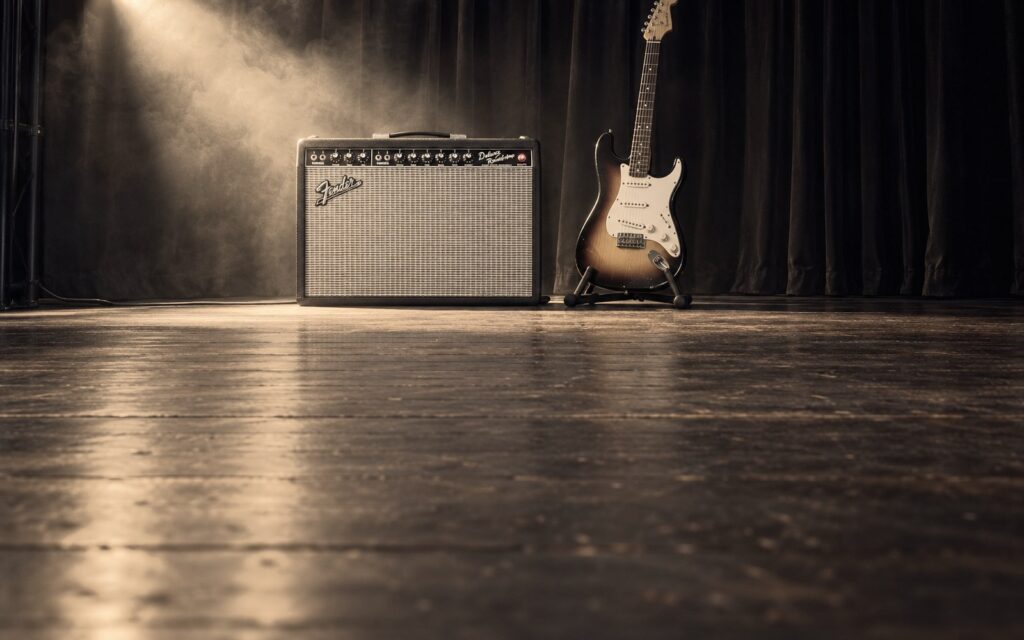
When guitarists discuss legendary amplifiers, the VOX AC30, Marshall Plexi, and Matchless DC30 often lead the conversation. But the Fender Deluxe Reverb deserves equal attention, especially from players who value clarity, warmth, and dynamics.
A Little History Behind the Deluxe Reverb
Fender introduced the Deluxe Reverb in 1963. Its blackface-era design became known for sparkling cleans, built-in spring reverb, and smooth tube-driven tremolo, which Fender called “Vibrato.”
With roughly 22 watts, 6V6 output tubes, and a single 12-inch speaker, it offered enough volume for many live settings while retaining a manageable size. Turn it up, and its clean tones gradually give way to warm, natural breakup.
The amp became a favorite among blues, country, rock, and studio guitarists. Players such as Roy Buchanan showed how expressive a Fender Deluxe-style amplifier could be, and Fender continues to produce versions of the design today.
What Makes the Deluxe Reverb Sound So Good?
The Deluxe Reverb delivers a clear, open American clean tone: full lows, slightly scooped mids, and smooth, sparkling highs. It responds naturally to touch, offering crisp note definition when played softly and gentle grit and compression when pushed.
Its clean headroom also makes it an excellent pedal platform. Overdrive pedals can provide additional gain while preserving the amp’s distinctive Fender foundation. Add the built-in spring reverb, and you have a complete, highly usable sound.
How Does It Fit Into Contemporary Worship Music?
Modern worship guitarists often favor VOX AC30s, Matchless DC30s, and Bad Cat amplifiers for their chime, strong midrange, and ability to cut through dense arrangements. The Deluxe Reverb offers a different strength: spacious, articulate cleans that suit softer songs, melodic picking, clean rhythm parts, and ambient textures.
With delay and reverb, it can create wide, atmospheric sounds without losing note definition.
Its main challenge is a dense full-band mix. The naturally scooped midrange can disappear behind keyboards, acoustic guitars, vocals, and heavily processed effects. It also lacks the midrange-forward chime and aggressive breakup associated with British-style amps.
Fortunately, modest midrange EQ, a suitable overdrive pedal, and careful control of the bass can help it sit more effectively. For players who prefer a cleaner, more traditional electric guitar sound, those characteristics may be an advantage rather than a limitation.
What About Today’s Digital Modelers?
Digital modelers make it easy to explore the Deluxe Reverb’s character without owning a tube amp. Whether you use a Line 6 Helix, Stadium, Fractal, or another platform, a Deluxe Reverb-inspired model or capture can provide a useful foundation for worship presets.
Comparing it with American and British amp models using the same guitar, pedals, and effects also reveals how strongly the amplifier shapes the final tone.
So, Is the Deluxe Reverb a Good Worship Amp?
Absolutely—especially if you want warm, articulate cleans, responsive dynamics, and a pedal-friendly platform. A VOX AC30 or Matchless DC30 may reach bright, chimey, midrange-driven breakup more naturally, but the Deluxe Reverb offers a spacious alternative that can serve worship music beautifully.
It may not be the most obvious choice for contemporary worship, but great guitar tone is not about following the most popular amp trend. It is about finding a sound that inspires you and supports the music.