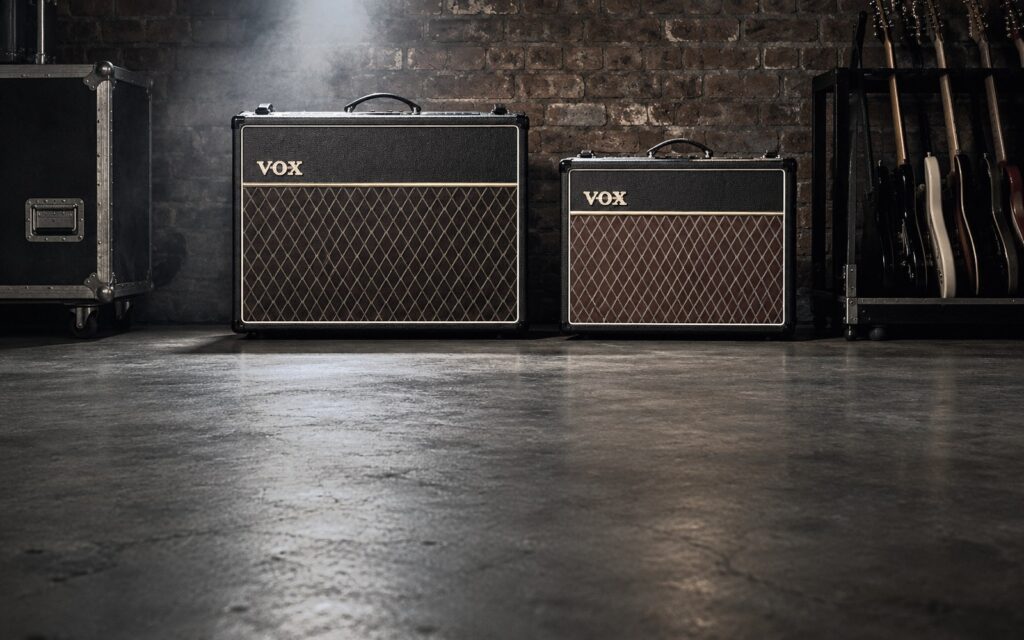
There are certain guitar amplifiers that have become almost as legendary as the musicians who played through them. The Fender Twin Reverb, Marshall Plexi, and, of course, the unmistakable VOX AC30.
If you’ve ever listened to The Beatles, Queen, U2, or some of today’s contemporary worship guitarists, chances are you’ve heard the distinctive sound of an AC30.
And what’s interesting is that this legendary amplifier has been around for more than 65 years.
It All Started in England
The story begins in 1958, when British amplifier designer Dick Denney helped develop the VOX AC15 for Jennings Musical Industries. It was a great little amplifier, but guitarists were beginning to play larger venues and needed something with more power.
In 1959, VOX introduced the AC30, essentially giving guitarists a louder, more powerful version of the AC15.
With its 30-watt tube design, distinctive British character, and eventually its famous diamond-pattern grille cloth, the AC30 quickly became one of the most recognizable amplifiers in music.
But what really made it famous wasn’t necessarily the technology. It was the musicians who plugged into it.
The British Invasion Changed Everything
One of the earliest groups to help put VOX on the map was The Shadows, with guitarist Hank Marvin helping establish that bright, clean British guitar sound.
Then came The Beatles.
John Lennon and George Harrison used VOX amplifiers during the band’s early years, and those famous black-and-beige amps became part of the visual identity of Beatlemania. As their concerts grew larger, they eventually moved to more powerful VOX models, but the AC30 had already earned its place in rock history.
And the list of famous AC30 players didn’t stop there.
Brian May of Queen took the AC30 in an entirely different direction. Using his homemade Red Special guitar, a treble booster, and multiple AC30 amplifiers, he developed that rich, singing, harmonically layered guitar tone we recognize almost immediately.
Then there’s The Edge from U2, whose combination of VOX AC30 tones, rhythmic delays, and atmospheric playing helped define an entirely different approach to electric guitar.
Personally, I think that’s one of the most fascinating things about the AC30. The same basic amplifier can produce the chime of early British rock, the soaring leads of Queen, and the spacious, ambient guitar sounds associated with U2.
So, What’s So Special About the AC30 Sound?
Guitarists often describe the AC30 as having chime, sparkle, warmth, and bite.
It can sound beautifully clean when played gently, but push it harder and it develops a wonderfully musical breakup. It also responds to how you play, making it especially appealing to guitarists who like controlling their tone with their picking dynamics and guitar volume knob.
The famous Top Boost circuit, introduced in the early 1960s, helped give the AC30 even more of that bright, articulate sound many guitarists associate with it today.
From Classic Rock to Contemporary Worship
One reason I find the AC30 so interesting is how well its sound has carried into modern music.
That combination of clarity, midrange character, and natural breakup works especially well with delay and reverb. It’s no surprise that VOX-inspired tones remain popular with guitarists playing ambient rock and contemporary worship music.
And of course thanks to today’s digital modelers, you don’t necessarily need a heavy, loud tube amplifier to experience that character. Devices like the Line 6 Helix, Stadium, Fractal, and Quad Cortex offer AC30-inspired amp models or captures that bring much of that classic British sound into a modern guitar rig.
A Classic That Never Really Went Away
More than six decades after its introduction, the VOX AC30 is still being used, modeled, and celebrated by guitarists around the world.
Not bad for an amplifier originally designed to help British guitar players be heard over screaming audiences.
For me, that’s what makes the AC30 special. It’s not just an old amplifier with an interesting history. It’s a sound that has connected generations of guitar players, from The Shadows and The Beatles to Queen, U2, and the worship music many of us enjoy playing today.
And that familiar VOX chime? It’s just as appealing now as it was back in 1959!