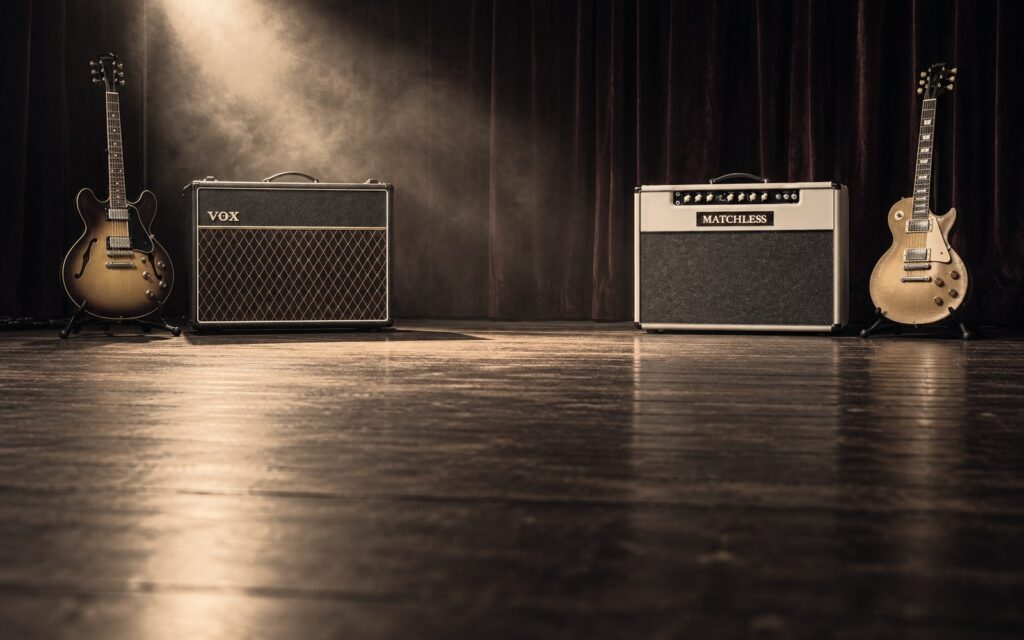
If you’re a fan of that beautiful, chimey British guitar sound made famous by the VOX AC30, there’s another amplifier worth knowing about: the Matchless DC30.
It’s one of those amplifiers that may not be as familiar to the average music listener as a Marshall or Fender, but among guitarists, it’s something of a legend.
And its story is especially interesting because it helped launch the boutique amplifier movement and eventually influenced another well known name, Bad Cat.
A New Take on a Classic British Sound
The Matchless story began in California in 1989, when Mark Sampson, Rick Perrotta, and Chris Perrotta set out to build high-quality, hand-wired tube amplifiers.
Their goal wasn’t simply to copy existing amplifiers. They wanted to take the character of classic British designs, particularly the VOX AC30, and build something with exceptional craftsmanship, reliability, and tone.
The result was the Matchless DC30, introduced around 1990.
The DC30 featured a 30-watt, EL84 powered design, two distinctly voiced channels, and a wonderfully responsive sound that could go from sparkling cleans to rich, harmonically complex overdrive.
It had some of that familiar VOX chime, but with its own personality: a bigger, more muscular sound with remarkable touch sensitivity.
The Guitarists Who Made Matchless Famous
During the 1990s, Matchless amplifiers began appearing on stages and in recording studios with some very influential musicians.
Phil Keaggy, known for his expressive guitar playing and Christian music, was among the notable artists associated with Matchless amplifiers.
The Edge of U2 also became associated with Matchless, adding the brand to a guitar world already fascinated by his atmospheric tones and signature use of delay.
And Peter Buck of R.E.M. was another prominent guitarist connected with Matchless during the alternative-rock era.
Artists across rock, country, and contemporary Christian music helped build the company’s reputation. Matchless became a name guitarists associated with exceptional tone rather than mass-market production.
The Bad Cat Connection — A New Chapter
Here’s where the story gets particularly interesting.
Despite its growing reputation, the original Matchless company ran into financial difficulties and closed in 1998.
Mark Sampson, one of the key designers behind the original Matchless amplifiers, later became involved with Bad Cat Amplifiers, a new California amplifier company founded around 1999–2000.
Bad Cat wasn’t simply Matchless under a different name. It was a separate company, but Sampson’s involvement brought some of the same design philosophy and tonal DNA into its early amplifiers.
The Bad Cat Black Cat, in particular, carried forward the idea of a premium, EL84-powered amplifier with beautiful cleans, rich harmonic detail, and the ability to produce a wonderfully dynamic overdriven sound.
In many ways, the Black Cat became a spiritual cousin to the Matchless DC30.
Interestingly, Matchless itself was eventually revived, so both companies continued developing their own amplifiers rather than one simply replacing the other.
Why Guitarists Still Love These Amps
What I find fascinating about the Matchless DC30 and Bad Cat Black Cat is how well their basic sound works for so many different styles of music.
They can produce that familiar British chime, but they also have a fullness and richness that makes single-note melodies sound beautiful.
Add a little overdrive, delay, and reverb, and it’s easy to understand why these types of amplifiers became popular with ambient and contemporary worship guitarists.
Today, you can explore that same tonal family through modern digital modelers such as the Line 6 Helix and Stadium, Fractal, and other platforms offering Matchless and Bad Cat inspired models or captures.
A Legacy Bigger Than One Amplifier
The Matchless DC30 wasn’t just another boutique tube amp. It helped demonstrate that guitarists were willing to invest in carefully built amplifiers that prioritized sound, feel, and craftsmanship.
And through Mark Sampson’s later involvement with Bad Cat, its influence continued into another generation of amplifier designs.
For me, the interesting part is how a sound rooted in the British amps of the 1960s evolved into something new in the 1990s and continues to inspire guitarists today.
Whether it’s a vintage VOX AC30, a Matchless DC30, or a Bad Cat Black Cat, there’s something about that combination of chime, warmth, and natural tube breakup that never seems to go out of style.