Ever wonder why that perfect guitar preset you created at home suddenly sounds completely different when you play it somewhere else?
If you're like me, you've probably spent plenty of time dialing in a great guitar tone on your Line 6 Helix, Stadium, Fractal, or another digital modeler.
You finally get everything sounding just right. The cleans are warm and clear, the overdrive is smooth, and your delays and reverbs sound fantastic.
Then you plug into a different set of speakers, or show up at rehearsal and connect to the PA system, and suddenly your favorite preset sounds too bright, muddy, thin, or just plain different.
So what happened? Did something change in your preset?
Probably not.
The Speakers Are Part of Your Guitar Tone
One thing I've learned about digital modeling is that the device you're listening through can have a tremendous influence on what you actually hear.
Unlike a traditional guitar amplifier, where the speaker cabinet is a major part of the sound, digital modelers often recreate the amplifier, speaker cabinet, and microphone electronically.
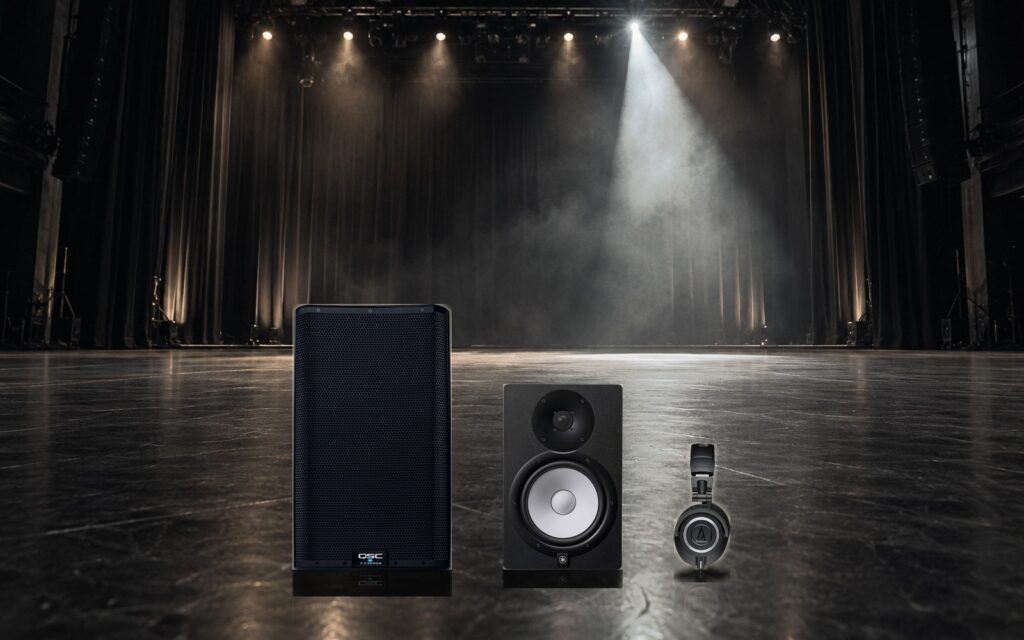
But that finished sound still needs to come through something, whether it's headphones, studio monitors, or a PA system.
And each of those listening environments has its own personality.
Headphones — Great Detail, But a Different Experience
Headphones are wonderful for practicing and creating presets, especially when you don't want to disturb anyone.
They let you hear subtle details, stereo delays, reverbs, and little nuances that might get lost through speakers.
But headphones can also make your guitar sound more spacious and isolated than it will in a live setting.
Because the sound is delivered directly to your ears, you don't experience the room acoustics or the natural interaction between speakers and the surrounding space.
And depending on the headphones, certain frequencies may be emphasized or reduced.
That beautiful, wide stereo preset might sound amazing through headphones but feel quite different through a live PA.
Studio Monitors — A More Natural Listening Experience
Good studio monitors are designed to reproduce sound accurately, making them useful for building and evaluating guitar presets.
Unlike headphones, you're hearing the sound travel through the air and interact with the room.
That can provide a more natural sense of how your guitar might sound through a speaker system.
But here's the catch: even high-quality studio monitors are influenced by the room they're in.
Speaker placement, nearby walls, room reflections, and bass buildup can all change what you're hearing.
A preset that sounds balanced in a small home studio may still need some adjustment when played through a larger system.
PA Speakers — Where Things Get Interesting
PA systems introduce another set of variables.
Different speakers, subwoofers, mixers, room acoustics, and sound system EQ settings can all influence your guitar tone.
And when you're playing with a full band, you're no longer hearing your guitar by itself.
The bass, drums, keyboards, acoustic guitars, and vocals all occupy parts of the same frequency range.
A guitar preset that sounds big and full at home might become muddy in the band mix. Or a beautifully smooth overdrive might need a little more midrange presence to be heard clearly.
For contemporary worship guitarists, this is especially noticeable because we often use spacious delays, reverbs, and ambient effects.
Those effects can sound incredible through headphones but become less defined when the entire band is playing.
Volume Makes a Difference, Too
Here's something that's easy to overlook.
Our ears perceive bass, midrange, and treble differently depending on how loudly we're listening.
A preset created at a quiet bedroom volume can sound brighter, fuller, or more aggressive when played through a louder PA system.
That's one reason I think it's helpful to occasionally evaluate presets at something closer to your normal playing volume, while keeping listening levels safe.
So, How Do You Get More Consistent Guitar Tone?
I don't think the answer is creating completely different presets for every speaker system you might encounter.
Instead, start with a good, balanced preset and learn how it translates between your headphones, monitors, and live sound system.
Sometimes a small EQ adjustment is all that's needed.
Other times, reducing excessive bass, controlling harsh upper frequencies, or dialing back delay and reverb can make a noticeable difference.
And if you're playing live, remember that what you hear on stage isn't necessarily what the audience hears through the main PA speakers.
That's where working with your sound technician can be particularly helpful.
My Take — Trust Your Ears, But Understand What You're Hearing
One of the greatest advantages of modern guitar modelers is their flexibility. We can create incredibly realistic amplifier tones without hauling around a collection of heavy tube amps.
But that flexibility also means understanding that our listening environment is part of the equation.
Headphones, studio monitors, and PA speakers each have their strengths, and none will necessarily sound identical.
The goal isn't to make your preset sound exactly the same everywhere. It's to create a tone that translates well wherever you play.
And sometimes, the difference between a great guitar tone at home and a great guitar tone on stage has less to do with your modeler than with what you're listening through.
One Simple Thing to Try Before Your Next Rehearsal
Take your favorite preset and listen to it through two different sources, perhaps your headphones and studio monitors. Pay attention to what changes. Does the bass become muddy? Are the highs suddenly harsh? Does the reverb seem overwhelming?
Rather than rebuilding the preset, make a few small EQ or effects adjustments and see if you can find a balance that works well through both.
Then, at your next rehearsal, listen to how that same preset fits with the full band. Pro Tip: If possible, ask your sound technician how it's coming through the main PA and what EQ they may have implemented. Know your gear. Be prepared to make subtle adjustments on-the-fly at rehearsal or sound check.
The real takeaway? Don't judge your guitar tone through just one set of speakers.
A little time listening in different environments can save you hours of unnecessary preset tweaking and help you build guitar sounds you can trust, whether you're practicing at home or playing live.