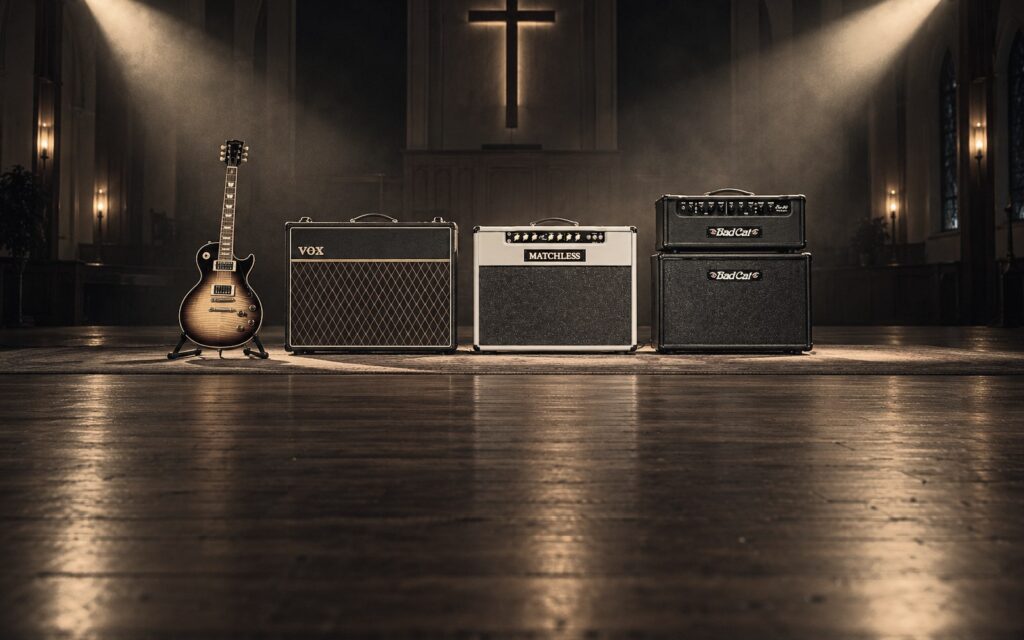
Who says you need a Telecaster or an expensive boutique guitar to get great contemporary worship tones?
Spend a little time watching worship guitarists on YouTube, and you'll probably notice a familiar trend. Lots of Telecasters, Stratocasters, and beautiful boutique guitars from companies like Veritas, Novo, and Jennings.
And there's a good reason for that. Those guitars often deliver the bright, articulate, chimey tones that have become so popular in modern worship music.
But what about the good old Gibson Les Paul?
I've always loved the sound and feel of a Les Paul, especially that thick, singing tone you get from its humbuckers. And the more time I spend experimenting with worship guitar sounds, the more convinced I become that a Les Paul deserves a place on the worship stage.
The Les Paul Has More Versatility Than You Might Think
Most guitarists associate a Les Paul with classic rock, blues, and those big, crunchy Marshall tones.
And there's no question it excels at those sounds.
But what sometimes gets overlooked is just how beautiful a Les Paul can sound when played clean.
The neck pickup can produce warm, smooth melodies, while the bridge pickup delivers clarity and bite. And the middle position, blending both humbuckers, can create a wonderfully balanced tone that works especially well for clean rhythm parts and ambient playing.
One of the things I particularly enjoy is how much tonal variety you can get simply by adjusting the guitar's volume and tone controls.
You don't always need another pedal or a different preset.
But What About That Famous Worship Guitar Chime?
Let's be fair. A traditional Les Paul with humbuckers isn't going to sound exactly like a Telecaster with single coils.
Humbuckers generally have a fuller, thicker character, while single coils tend to deliver more top-end sparkle and snap.
But that doesn't mean a Les Paul can't produce bright, articulate worship tones.
Pair it with a VOX AC30, Matchless DC30, or Bad Cat-inspired amplifier, and you might be surprised how much clarity and chime you can bring out.
A little EQ adjustment, some carefully chosen compression, and the right amount of delay and reverb can go a long way.
And when it's time for a bigger chorus or a soaring lead line, those humbuckers really start to shine.
Where the Les Paul Really Excels
For me, one of the Les Paul's biggest strengths is its ability to move naturally between clean and driven sounds.
It can deliver warm, expressive clean parts during a quiet verse, then transition into a thick, smooth overdrive when the song builds.
That natural fullness can be especially appealing for melodic lead lines and powerful rhythm sections.
Of course, there's a tradeoff. Too much low-mid warmth can make a Les Paul sound muddy in a busy worship mix. Sometimes tightening the bass and bringing out a little upper-mid clarity makes all the difference.
But that's really no different from learning how to get the best out of any guitar.
Modern Modelers Make It Even Easier
With today's digital modelers, including the Line 6 Helix, Stadium, Fractal, and Quad Cortex, we have more flexibility than ever.
You can experiment with different amp models, EQ settings, overdrive pedals, and effects to bring out the best characteristics of your guitar.
And that's something I've come to appreciate. Rather than constantly searching for another guitar to get a particular sound, sometimes it's more rewarding to learn how to get that sound from the guitar you already own.
So, Do You Really Need a Different Guitar for Worship?
Not necessarily.
If you love the bright, snappy sound of a Telecaster, there's nothing wrong with choosing one. And if a boutique guitar inspires you to play more, that's great too.
But don't overlook a Les Paul simply because it doesn't fit the typical modern worship guitar image.
There's something special about its combination of warmth, sustain, versatility, and natural overdrive.
And honestly, I think there's room for more than one kind of guitar sound in contemporary worship music.
At the end of the day, great worship guitar tone isn't about having the same guitar everyone else is playing. It's about finding a sound that complements the music and inspires you to play your best.
And a Les Paul can absolutely do that.