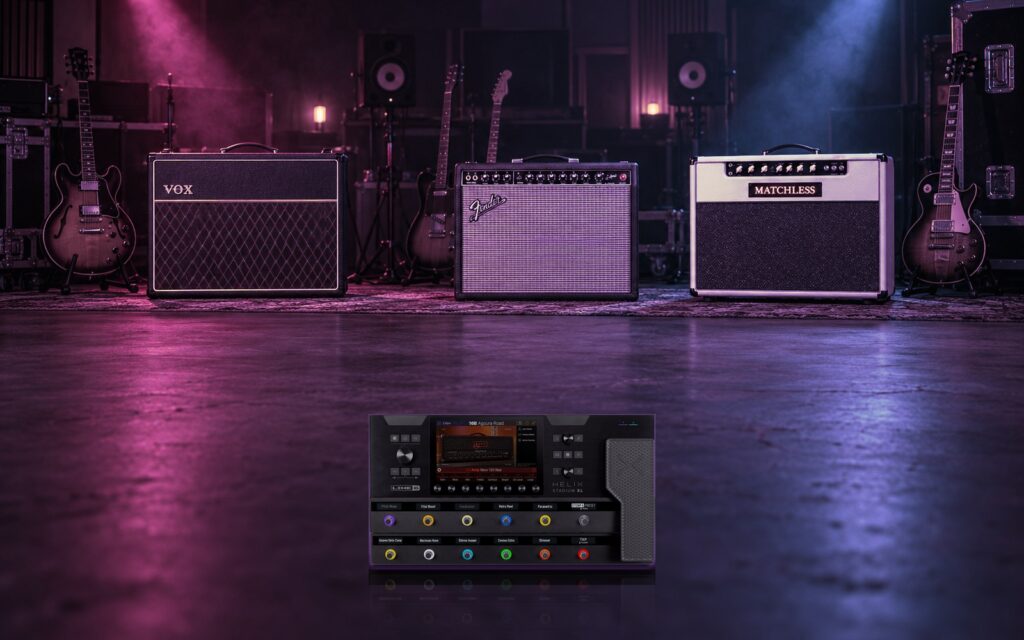
With the arrival of the Line 6 Helix Stadium and its Proxy technology, guitarists have more ways than ever to experience the sound of their favorite amplifiers.
If you've spent any time exploring modern guitar modelers, you've probably noticed two terms that come up quite often: amp models and amp captures.
For years, digital modeling has allowed us to enjoy the sounds of classic amplifiers like the VOX AC30, Fender Deluxe Reverb, Marshall Plexi, and Matchless DC30 without actually owning them.
Now, with technologies like Neural Capture, Kemper Profiling, and Line 6's Proxy engine, there's another way to bring those famous amplifier sounds into our digital rigs.
But what's the difference, and does one actually sound better than the other?
Traditional Amp Modeling — Recreating How an Amplifier Works
Traditional amp modeling attempts to recreate the behavior of a real amplifier by digitally simulating its circuitry and how the different components interact.
Think of it as building a virtual version of an amplifier.
When you adjust the gain, bass, midrange, treble, or master volume, the model responds in ways designed to resemble the original amplifier.
One of the biggest advantages is flexibility.
You can start with a clean VOX-style sound, increase the gain, adjust the tone controls, and explore how the amplifier responds across a wide range of settings.
Modern modeling has become incredibly sophisticated, and the results can be remarkably convincing.
Amp Captures — Recreating the Sound of a Particular Amp Setup
Amp capturing approaches things a little differently.
Rather than recreating an amplifier's individual circuits, capture technology analyzes how a real amplifier responds to test signals and creates a digital representation of that behavior.
Think of it as capturing the personality of an amplifier at a particular set of settings.
For example, someone might capture a Matchless DC30 dialed in for a beautiful edge-of-breakup sound. Load that capture into your modeler, and you can experience much of that amplifier's tone and playing response without owning the original.
But here's an important distinction: Captures aren't necessarily fixed, one-sound snapshots.
Many capture systems, including Line 6 Proxy, provide adjustable controls for shaping gain, tone, and output level.
The limitation is that these adjustments don't always behave exactly like turning the knobs on the original amplifier. For example, increasing the gain on a clean amp capture may add distortion, but it won't necessarily respond the same way as increasing the gain on the real amplifier.
Some capture technologies offer more sophisticated control than others, but generally speaking, captures are most accurate near the settings where the original amplifier was captured.
That's one of the things I find interesting about captures. You're often experiencing how someone else has carefully dialed in an amplifier, while still having some flexibility to make that sound your own.
Where Line 6 Stadium Proxy Fits In
With the Helix Stadium, Line 6 introduced its Proxy technology, bringing amp and pedal capturing into the Stadium platform alongside traditional amp modeling.
That opens up some interesting possibilities.
You can use traditional amp models when you want the freedom to shape an amplifier's behavior with familiar controls, or explore Proxy captures when you want to start with a particular amp or pedal sound that someone has already captured.
And there's no reason you can't use both approaches within your overall preset collection.
For guitarists who enjoy experimenting with different amplifier tones, it's a pretty exciting combination.
So, Which One Sounds Better?
This is where things get interesting.
A great amp capture can sound remarkably close to the original amplifier at the settings where it was captured.
But a well-designed amp model generally offers greater flexibility when you want to make significant changes to the amplifier's gain structure or tone controls.
And here's something worth remembering:
A great capture isn't automatically better than a great amp model.
The quality of the original amplifier, the capture process, the cabinet or speaker simulation, and the way everything is dialed in can make a tremendous difference.
I've heard traditional amp models that sound fantastic and captures that are equally impressive.
Ultimately, the better choice is the one that delivers the sound and playing response you're looking for.
What Does This Mean for Worship Guitarists?
For contemporary worship players, both approaches have plenty to offer.
Traditional amp models make it easy to build versatile presets with clean, edge-of-breakup, and driven tones.
Captures can provide a wonderful starting point when you're chasing a particular sound, such as a carefully dialed-in Matchless, Bad Cat, or VOX-inspired amplifier.
Add your favorite compression, overdrive, delay, and reverb, and either approach can become the foundation of an excellent worship guitar preset.
My Take — It's Nice to Have Both
Personally, I don't see amp modeling and amp capturing as competing technologies.
I see them as two different ways of reaching the same goal.
Sometimes I want the flexibility of an amplifier model that I can adjust extensively. Other times, I simply want to load a great-sounding capture and start playing.
And that's what makes today's modelers so interesting.
We're no longer limited to choosing between a handful of digital amplifier simulations. We can explore traditional models, captures of real amplifiers, and combinations of both.
At the end of the day, the technology matters a lot less than what comes out of the speakers.
If it sounds great, responds naturally to your playing, and inspires you to pick up your guitar, does it really matter whether it's a model or a capture?