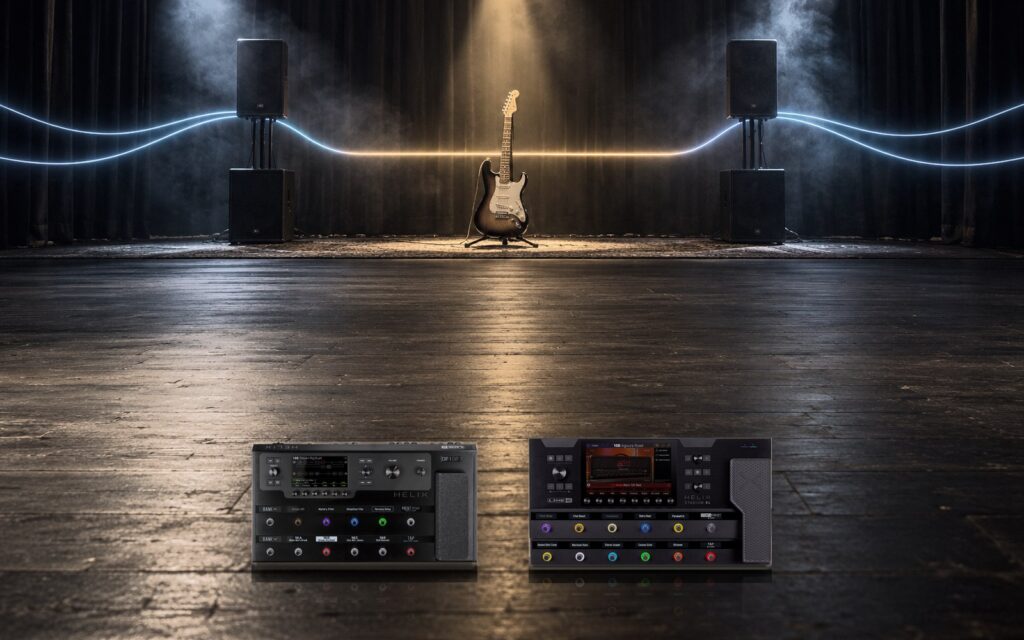
If you've spent any time exploring modern worship guitar tones, you've probably noticed how much attention is given to stereo effects.
Wide delays, spacious reverbs, ping-pong echoes, and those beautiful ambient guitar sounds that seem to surround you.
And I'll admit, there's something pretty impressive about plugging into a Line 6 Helix, Stadium, or another digital modeler, putting on a good pair of headphones, and hearing your guitar spread across a huge stereo soundstage.
But here's a question worth asking: Do we really need stereo guitar effects when playing live worship music?
The answer might surprise you.
Why Stereo Sounds So Good
There's no question that stereo effects can sound fantastic.
A stereo delay can bounce repeats between the left and right speakers, while a stereo reverb can create a sense of space and depth that makes even a simple guitar part sound enormous.
For contemporary worship guitarists, where ambient textures and atmospheric sounds are often part of the music, stereo effects can be especially appealing.
And when you're practicing at home through headphones or two studio monitors, the difference between stereo and mono can be pretty dramatic.
But what sounds incredible at home doesn't always translate the same way in a church sanctuary.
The Reality of Live Sound
Here's something I think we sometimes overlook.
Just because your guitar modeler is sending a stereo signal to the soundboard doesn't necessarily mean everyone in the congregation is hearing that same stereo image.
Depending on the church's sound system, speaker placement, and where people are sitting, the stereo effect may be much less noticeable than you'd expect.
Someone sitting near the left side of the room might hear mostly the left speaker, while someone on the opposite side hears more of the right.
And in some churches, the sound system is actually configured for mono, even if the mixer has stereo capabilities.
So that beautiful ping-pong delay you spent hours perfecting might not translate the way you imagined.
Mono Isn't Necessarily a Compromise
One thing I've come to appreciate is just how good a well-designed mono guitar tone can sound.
A great amp model or capture, a little compression, some tasteful overdrive, and a good delay and reverb can create a wonderfully spacious sound without relying on stereo separation.
In fact, mono can sometimes provide a more consistent listening experience for everyone in the room.
Your guitar tone stays centered, your delay repeats remain audible, and you don't have to worry as much about how the left and right channels are being distributed.
And let's face it, plenty of legendary guitar tones were created using a single amplifier and speaker cabinet.
When Stereo Really Makes Sense
Now, I'm certainly not suggesting stereo is unnecessary.
If your church has a well-designed stereo PA system, your sound technician supports stereo guitar inputs, and your playing style relies heavily on ambient effects, stereo can add something special.
It can also be particularly useful with in-ear monitors, where stereo delays and reverbs can create a more immersive playing experience.
And with modern digital modelers, running stereo effects is relatively easy.
But there's a difference between enjoying stereo effects in your own monitors and knowing how those effects translate to the congregation.
Both are worth considering.
One Thing to Watch Out For — Stereo Effects in Mono
Here's a practical detail that's easy to miss.
Not every stereo effect sounds exactly the same when combined into mono.
Some stereo chorus, delay, and modulation effects use differences between the left and right channels to create their sense of width.
When those signals are combined, certain frequencies can partially cancel each other, changing the sound or making an effect less noticeable.
That doesn't mean stereo effects are bad. It simply means it's worth checking how your preset sounds in mono before using it live.
And remember, connecting only the left output of a stereo rig isn't always the same as properly summing both channels to mono.
My Take — Great Worship Tone Isn't About How Wide It Sounds
Personally, I think stereo effects are a wonderful creative tool, especially for ambient worship guitar.
But I also think it's easy to get caught up in creating the biggest, widest sound possible without considering how that sound fits into the overall band.
Sometimes a simple mono guitar tone with well-chosen effects can be every bit as musical and effective.
And in a busy worship mix, clarity and consistency often matter more than stereo width.
A Simple Test Before Your Next Rehearsal
Take one of your favorite stereo presets and listen to it in both stereo and mono, using your modeler's proper mono routing or summing options.
Pay attention to what happens to your delays, reverbs, and modulation effects. Does anything disappear or change dramatically?
Then ask your sound technician whether your guitar is actually being mixed in stereo through the main PA.
You might discover that stereo adds something valuable to your setup. Or you might find that a simpler mono rig gives you everything you really need.
At the end of the day, the goal isn't to create the widest guitar sound possible. It's to create a guitar sound that serves the music and reaches the congregation clearly.
And sometimes, one great guitar signal is all it takes.