Why two lower-gain drives can be more useful than one high-gain pedal
If you've spent any time experimenting with guitar pedals or digital modelers, you've probably come across the idea of stacking overdrives.
At first, it might seem a little unnecessary. Why use two overdrive pedals when you could simply turn up the gain on one?
That's a fair question, and it's something I wondered about when I first started exploring different guitar tones.
But the more you experiment with stacking overdrives, the more you begin to appreciate just how much flexibility it can offer.
It's Not Just About Adding More Distortion
One of the biggest misconceptions about stacking overdrives is that the goal is simply to create more gain.
Sometimes that's true, but there's a lot more to it.
Different overdrive pedals have their own tonal personalities. Some emphasize midrange frequencies, others have a more transparent character, and some add compression, warmth, or a little extra bite.
When you combine two lower-gain pedals, you're not just increasing distortion. You're blending their characteristics to create something neither pedal might produce on its own.
And that's where things get interesting.
Two Pedals, Several Different Sounds
Think about having two overdrive pedals, each set with relatively modest gain.
The first might be a transparent-style drive, such as a Timmy, that adds a little warmth and natural breakup without dramatically changing your guitar's character.
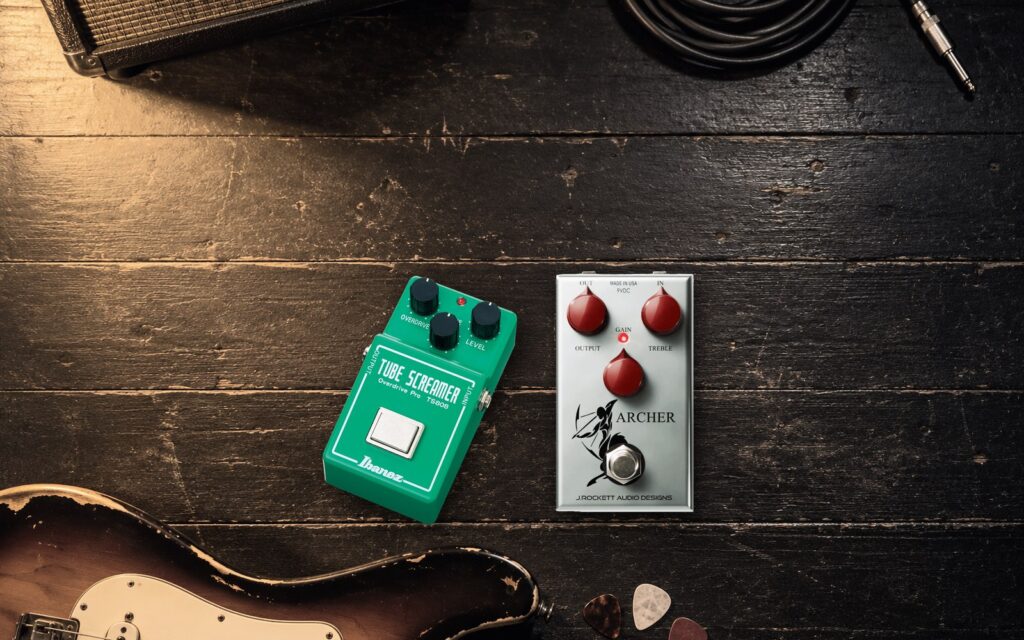
The second might be a Tube Screamer-style pedal, which emphasizes the midrange and tightens up the low end.
Used separately, each pedal gives you a different flavor of overdrive.
But engage them together, and you can create a fuller, more sustaining tone with additional compression and midrange presence.
Suddenly, those two pedals provide three useful driven sounds, not counting your basic clean amplifier tone.
And depending on how you set their gain and output levels, the combined sound doesn't necessarily have to be dramatically louder or more distorted.
Pedal Order Makes a Difference
Here's something I find particularly interesting about stacking drives.
The order of the pedals can change the sound considerably.
For example, placing a Tube Screamer-style pedal before a more transparent overdrive can push a midrange-focused signal into the second pedal, influencing how it breaks up.
Reverse the order, and the transparent drive pushes the Tube Screamer, often producing a different balance of compression, midrange, and saturation.
Neither arrangement is automatically better.
It's simply another way to shape your tone.
And sometimes switching the order of two pedals makes a bigger difference than adjusting their gain controls.
Why This Works So Well for Worship Guitar
Contemporary worship music is a great example of where stacked overdrives can be especially useful.
A softer verse might call for a clean or slightly driven sound. As the song builds, you may want a little more warmth and sustain.
Then, when the chorus opens up, engaging a second drive can add the fullness and energy needed without completely changing the character of your guitar.
That's something I really appreciate about stacking drives. You can move between different levels of intensity while maintaining a consistent underlying tone.
And because you're using relatively modest gain settings, individual notes and chords can remain more articulate than they might with excessive distortion.
Of course, too much gain or compression from both pedals can still make things muddy, so a little restraint goes a long way.
Digital Modelers Make Experimenting Easy
If you're using a Line 6 Helix, Stadium, Fractal, or another digital modeler, experimenting with overdrive stacking is especially convenient.
You can try different combinations without buying more pedals or rearranging a physical pedalboard.
For example, pairing a Klon-style overdrive with a Timmy or Tube Screamer-style pedal can produce some wonderful variations in tone.
And with snapshots, scenes, or footswitch assignments, you can move between individual drives and stacked combinations during a song.
It's a great way to get more useful sounds from a single preset.
One Thing I've Learned — More Gain Isn't Always Better
It's tempting to keep turning up the gain, especially when you're looking for a thick, sustaining lead tone.
But sometimes reducing the gain on both pedals and letting them work together produces a clearer, more responsive sound.
You retain more of your guitar's natural character, and your picking dynamics can still influence how the tone responds.
In a full band, that extra clarity can be far more valuable than simply adding more distortion.
My Take — Two Good Drives Can Be Better Than One
I'm not suggesting everyone needs two overdrive pedals. A single well-chosen drive can sound fantastic, and plenty of guitarists get excellent results with just one.
But if you're looking for more flexibility without constantly switching presets or changing amplifier settings, stacking two lower-gain drives is definitely worth exploring.
Here's something simple to try: Set two different overdrives with relatively low gain, listen to each individually, and then engage them together. Pay attention to how the tone changes, not just how much distortion you hear.
You might discover that the combination gives you exactly the sound you've been looking for.
And that's really the beauty of stacking overdrives.
It's not about having more pedals or more gain.
It's about having more control over the way your guitar sounds and responds when you play.
A Simple Starting Point for Stacking Two Overdrives
If you're new to stacking overdrives, here's a combination worth trying, whether you're using actual pedals or a digital modeler like the Line 6 Helix or Stadium.
Start with a Timmy-style transparent overdrive followed by a Tube Screamer-style pedal.
Pedal 1 — Timmy-Style Overdrive (First in Chain)
- Gain: 9–10 o'clock (approximately 20–30%)
- Tone/EQ: Start near neutral
- Level: Set for roughly equal volume when engaged
- Purpose: Adds a little warmth, grit, and natural breakup while retaining your guitar's character.
Pedal 2 — Tube Screamer-Style Overdrive (Second in Chain)
- Gain: 8–9 o'clock (approximately 10–20%)
- Tone: Around noon
- Level: Slightly above unity, if needed
- Purpose: Adds midrange focus, tighter bass, and a little extra sustain.
What You Should Hear
With the Timmy engaged, you should have a slightly driven rhythm tone. Engage the Tube Screamer by itself for a more focused, midrange-forward sound.
Turn on both, and you should hear additional saturation, compression, and sustain without losing too much note clarity.
If the combined sound becomes muddy or overly compressed, try reducing the gain on one or both pedals. If it becomes harsh, back off the tone or level feeding the second drive.
One Last Tip: Try reversing the pedal order. You'll often discover a noticeably different character, even with the exact same settings.
These are simply starting points, not magic settings. Your guitar pickups, amplifier, and playing volume will all influence the results.
The goal is to find three useful overdrive sounds that complement each other, rather than three variations of the same distortion.